mongabay.com logo
apes blog News articles on apes

Weekly Newsletter | Syndicate / XML feed / RSS | Other topics

News articles on apes

Mongabay.com news articles on apes in blog format. Updated regularly.


Rainforest Reserve Established in DR Congo to save bonobo

(11/19/2007) The government of the Democratic Republic of Congo (DRC) has announced the creation of a 11,803-square mile rainforest reserve to protect the habitat of the endangered bonobo, the so-called "peaceful chimp". The reserve is located in the Sankuru region, an area that experienced extensive fighting during the long-running civil war in the Congo.


Missing link between humans and apes possibly discovered

(11/12/2007) A 10 million-year-old jawbone discovered in Kenya may represent a new species very close to the last common ancestor of gorillas, chimpanzees, and humans, report researchers writing in the current issue of the journal Proceedings of the National Academy of Sciences (PNAS).


Global warming puts primates at greater risk

(10/25/2007) 29 percent of the world's primate species are in danger of going extinct warns a new report from the Primate Specialist Group of IUCN's Species Survival Commission (SSC) and the International Primatological Society (IPS).


16,306 species threatened with extinction

(09/12/2007) 16,306 of 41,415 species on the IUCN Red List are threatened with extinction, reports the World conservation Union (IUCN). The total number of known extinct species now stands at 785, while a further 65 are only found in captivity or in cultivation. One in four mammals, one in eight birds, one third of all amphibians and 70% of the world's assessed plants on the 2007 IUCN Red List are considered at risk.


Toddlers have higher social cognition skills than apes

(09/06/2007) Toddlers have more sophisticated social learning skills than their closest primate relatives, researchers report in the 7 September issue of the journal Science.


Researchers head to Congo to study Bonobo psychology

(09/05/2007) Researchers have gone to the Democratic Republic of Congo to study the social behvaior of bonobos -- a close relative of the chimpanzee -- in the Lola ya Bonobo Sanctuary in Kinshasa.


Rebels invade Congo gorilla sanctuary, park rangers evacuated

(09/04/2007) Guerillas have invaded Virunga National Park in the Democratic Republic of Congo, causing park rangers to flee, and leaving critically endangered mountain gorillas at great risk, reports Wildlife Direct, a group that promotes wildlife protection through blogs by rangers and conservationists.


Photo: newborn mountain gorilla born in Congo

(08/23/2007) conservationists announced the birth of a critically endangered mountain gorilla in the Democratic Republic of Congo's Virunga National Park. The newborn marked a positive development for the embattled apes in the park -- nine out of its 100 gorillas have been killed this year by poachers, including five last month.


U.N. sends team to investigate gorilla killings

(08/10/2007) The U.N. said it will send a team of experts to probe the killings of critically endangered mountain gorillas in the Democratic Republic of the Congo (DRC). Four gorillas were shot "execution-style" last month, while three others have been killed so far this year. Rangers believe illegal charcoal harvesters from Goma are to blame.


Rare gorillas slaughtered in mass killing

(07/24/2007) At least four critically endangered gorillas have been killed in Democratic Republic of Congo's Virunga National Park. National Geographic News reports they were shot "execution-style". Illegal charcoal harvesters are leading suspects in the slaying. Two other gorillas are missing and feared dead.


Orangutans use water as a tool

(07/06/2007) German researchers have observed orangutans using water as a tool. Natacha Mendes, Daniel Hanus, and Josep Call of the Max-Planck-Institute for Evolutionary Anthropology in Leipzig, Germany conducted an experiment with five orangutans to see whether the red apes could access an out-of-reach peanut floating inside a vertical transparent tube. They quickly found that all five orangutans were able to do so by collecting water from a drinker and spitting it into the tube to raise the water level and win access to the peanut.


Time running out for world's rarest gorilla

(06/21/2007) Time is running out for the world's rarest subspecies of gorilla, the Cross River gorilla (Gorilla gorilla diehli) from the mountainous border region between Cameroon and Nigeria. With less than 300 individuals remaining, conservationists have drawn up a new plan to save the great ape from extinction.


98% of orangutan habitat gone in next 15 years

(06/11/2007) Indonesia is losing more than 2.1 million hectares (5.2 million acres) of forest a year to illegal loggers, states a new report from the U.N. Environment Program (UNEP). The report, which estimates the value of illicit timbering at $4 billion annually, warns that 98 percent of Indonesia's lowland forests will be gone by 2022, putting species like the orangutan at risk of extinction in the wild. The report, Last stand of the Orang-utan: State of Emergency, was released Monday at the Convention on International Trade in Endangered Species meeting in The Hague.


Human ancestors first walked in trees

(05/31/2007) Walking on two legs is likely to have first arisen among apes living in trees, rather than ground-dwelling prehistoric ancestors of humans, reports research published in the June 1st issue of the journal Science.


Congo guerillas threaten to kill rare gorillas

(05/21/2007) Fresh off killing a park ranger, a group of Congo guerillas said they will slaughter highly endangered mountain gorillas in Congo's Virunga National Park if their demands for immunity aren't met, says WildlifeDirect, a wildlife conservation organization active in the region.


Rare mountain gorillas in Uganda on the increase

(04/20/2007) High endangered mountain gorillas in Uganda are increasing, reports a new census by the Uganda Wildlife Authority, the Wildlife conservation Society, the Max Planck Institute of Anthropology and other groups. The population of gorillas in Bwindi Impenetrable National Park has increased from 320 in 2002 to 340 today. A 1997 study found 300 gorillas, indicating that the park population has increased by 20 percent over the past decade. Aggressive conservation measures have been the key say researchers.


Photos: Orangutans and tigers become playmates

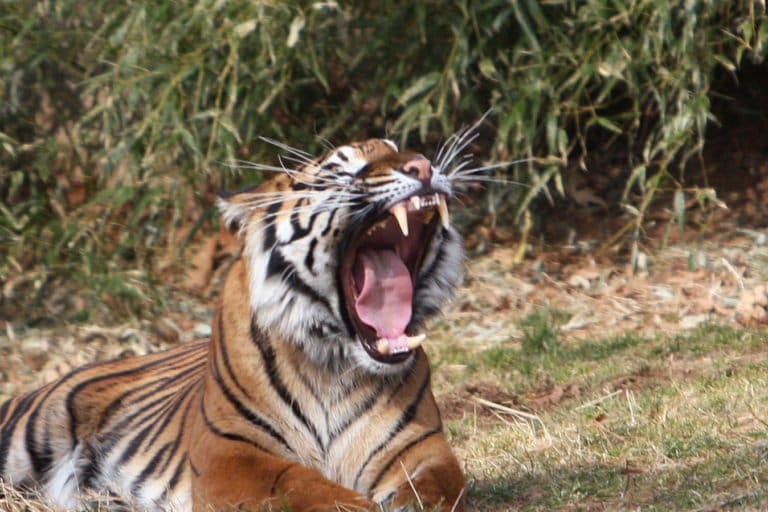
(02/28/2007) A pair of month-old Sumatran tiger twins have befriended a pair of young orangutans reports the Associated Press (AP). The animals share a room in the nursery at Taman Safari zoo in Sumatra. The AP reports that the animals, which were orphaned, 'cuddle' and play together.


Chimps and humans split 4 million years ago

(02/23/2007) New research using DNA analysis suggests that chimpanzees and humans split from a common ancestor just 4 million years ago -- much earlier than the 5-7 million years currently accepted by biologists. The study is published in Public Library of Science journal PLoS Genetics


Chimps hunt bush babies with spears

(02/22/2007) Researchers have observed wild chimpanzees in Senegal hunting bush babies with spears, according to a paper published in the March 6 edition of the journal Current Biology. The study is the first to report primates using tools for hunting other vertebrates.


98% of orangutan habitat in Borneo, Sumatra gone by 2022

(02/06/2007) A report from the United Nations Environment Programme (UNEP) today warns that illegal logging is rapidly destroying the last remaining habitat for orangutans in Borneo and Sumatra. The report says that up to 98 percent may be destroyed by 2022 without urgent action.


Captive chimpanzees 'talk' to humans

(01/29/2007) Captive chimpanzees use specific vocalizations to communicate with humans according to new research published in the current issue of the journal Animal Behaviour. The researchers, lead by Dr. William Hopkins of Yerkes National Primate Research Center at Emory University, say these sounds are not used in other contexts -- only to elicit attention from humans. The researchers say the findings may help explain the evolution of language in primates.


Congo guerillas agree to protect rare gorillas

(01/24/2007) Rebels in eastern Congo have agreed to stop hunting mountain gorillas according to a report from the Associated Press.


Apes sing for protection

(12/25/2006) White-handed gibbons in Thailand use songs as a defense against predators according to a study by researchers at the University of St Andrews in Scotland and the Max Planck Institute in Germany.


Ebola kills thousands of gorillas in African park

(12/07/2006) The Ebola virus, a nasty hemorrhagic fever that causes massive organ failure and bleeding, is killing thousands of endangered gorillas across Central African forests according to new research published in the journal Science. While the findings suggests that even in strictly protected wildlife sanctuaries gorillas are not safe, the research provides insight on how to control Ebola outbreaks among wild gorillas (Gorilla gorilla) and chimpanzees (Pan troglodytes).


Outbreak may be killing chimps in Guinea - Reuters

(12/03/2006) Endangered chimpanzees are disappearing in the West African country of Guinea according to a report from Reuters.


Evolution: less food = smaller brain in orangutans

(10/23/2006) A new study has linked diet to evolutionary brain size in orangutans living on the Indonesian islands of Borneo and Sumatra.


Orangutan population plunges 43% in Indonesia

(08/14/2006) The Wildlife conservation Society-Indonesia Program said that Indonesia's population of orangutans fell nearly 43 percent in the past decade, from 35,000 in 1997 to 20,000 today. The decline has been caused by ongoing forest destruction and poaching in Kalimantan (Borneo) and Sumatra, the only two islands that still support wild orangutans. Environmental groups have warned that red ape could be extinct in the wild without urgent conservation measures.


Orangutans and chimps are smarter than monkeys and lemurs

(08/01/2006) The great apes are the smartest of all nonhuman primates according to scientists at Duke University Medical Center. The researchers found that orangutans and chimpanzees consistently outperformed monkeys and lemurs on a variety of intelligence tests, conclusively proving that apes are more intelligent than monkeys and prosimians.


Bushmeat from African apes sold in American markets

(07/06/2006) Bushmeat from wild primates in Africa is ending up on plates in North America and western Europe according to an article published in the current issue of New Scientist. Justin Brashares, a wildlife biologist at the University of California at Berkeley who carried out a survey of clandestine markets in seven major cities, says that the meat, which includes chimpanzee and gorilla parts, makes up nearly a third of the illegal international trade in bushmeat killed in Africa.


Pictures of Gabon: gorillas, rainforest and white sand beaches

(06/26/2006) Mongabay.com, a leading rainforest and environmental web site, today announced the availability of new photos from the Central African country of Gabon. Site founder Rhett A. Butler visited Loango National Park in Gabon in late May and early June.


Chimps split from humans 5-7 million years ago says new study

(12/22/2005) Chimpanzees diverged from humans only 5-7 million years ago according to a newly released study of gene sequences. The research significantly narrows the time frame for the evolutionary split.


Congo gorillas survive war, survey finds higher count than expected

(09/30/2005) New scientific surveys by the Dian Fossey Gorilla Fund International in the Democratic Republic of Congo (DRC) have revealed some encouraging news about the status of the "eastern lowland" gorilla, known more properly as Grauer's gorilla.


Gorillas use tools - photo documentation

(09/29/2005) For the first time ever, scientists have observed and photographed wild gorillas using tools, in one instance employing a stick to test the depth of a pool before wading into it, according to a study by the Bronx Zoo-based Wildlife conservation Society (WCS) and other organizations. Up to this point, all other species of great apes, including chimpanzees and orangutans, have been observed using tools in the wild, but never gorillas.


WCS supports new primate protection agreement

(09/14/2005) The Bronx Zoo-based Wildlife conservation Society (WCS) announced today that a new international agreement signed last week in the Democratic Republic of Congo will play a key role in safeguarding and improving populations of the world's great apes, including gorillas, chimpanzees and orangutans.


Poverty decimates great apes

(09/05/2005) Fewer than 250 wild Sumatran orangutans may exist in fifty years, their habitat is disappearing and the devastation of the Asian tsunami has accelerated the rate of destruction. This is among the findings being announced at the launch of the first World Atlas of Great Apes and their conservation by the UNEP World conservation Monitoring Centre, which reveals that it is not just humans that will benefit from a campaign to 'make poverty history'. For the other 6 species of great ape -- the eastern and western gorilla, chimpanzee, bonobo, Sumatran and Bornean orangutan -- it could literally save them from the cooking pot.


Chimps and Humans Very Similar at the DNA Level

(09/01/2005) The first comprehensive comparison of the genetic blueprints of humans and chimpanzees shows that our closest living relatives share perfect identity with 96 percent of our DNA sequence, an international research consortium reported today.


Page 1 | Page 2 | Page 3 | Page 4


home | archives | news | XML / RSS feeds


XML / RSS / Syndication options

mongabay.com features more than 250 RSS feeds to meet your specific area of interest


WEEKLY NEWSLETTER
Email:


SUPPORT
Mongabay.com seeks to raise interest in and appreciation of wild lands and wildlife, while examining the impact of emerging trends in climate, technology, economics, and finance on conservation and development (more)

Help support mongabay.com when you buy from Amazon.com. Or donate to Mongabay directly


ABOUT
Mongabay provides conservation and environmental science news, information, and analysis.


About Mongabay
Founder: Rhett Butler
Copyright & Use
Contact
Contribute
Internships
Nature Blog Network


POPULAR PAGES
Rainforests
Rain forests
Amazon deforestation
Deforestation
Deforestation stats
Why rainforests matter
Saving rainforests
Amazon rainforest
Congo rainforest
Deforestation data
Rainforest canopy
For kids

Special sections
New Guinea
Finding new species
Sulawesi
Madagascar
Rainforests
Borneo
REDD
News
Most popular articles
Africa
Amazon
Animals
Brazil
Conservation
Climate Change
Deforestation
Energy
Featured
Happy-upbeat
Indonesia
Interviews
Madagascar
New species
Oceans
Palm oil
Rainforests
Strange
Wildlife
MORE TOPICS


PHOTOS
Indonesia photos
Brazil

Costa Rica photos
Costa Rica

Colombia photos
Colombia

Indonesia photos
Indonesia

Madagascar photos
Madagascar

Malaysia photos
Malaysia

Monkey photos
Monkeys

Peru photos
Peru

Colombia photos
Rainforests


All galleries


RELATED TOPICS
  • Bushmeat
  • Endangered Species
  • Lemurs
  • Mammals
  • Monkeys
  • Orangutans
  • Primates
  • Wildlife

    BLOGROLL/LINKS

  • Gorilla Protection"


  • Copyright mongabay1999-2013


    Carbon dioxide (CO2) emissions generated from mongabay.com operations (server, data transfer, travel) are mitigated through an association with Anthrotect,
    an organization working with Afro-indigenous and Embera communities to protect forests in Colombia's Darien region.
    Anthrotect is protecting the habitat of mongabay's mascot: the scale-crested pygmy tyrant.