mongabay.com logo
animals blog News articles on animals

Weekly Newsletter | Syndicate / XML feed / RSS | Other topics

News articles on animals

Mongabay.com news articles on animals in blog format. Updated regularly.


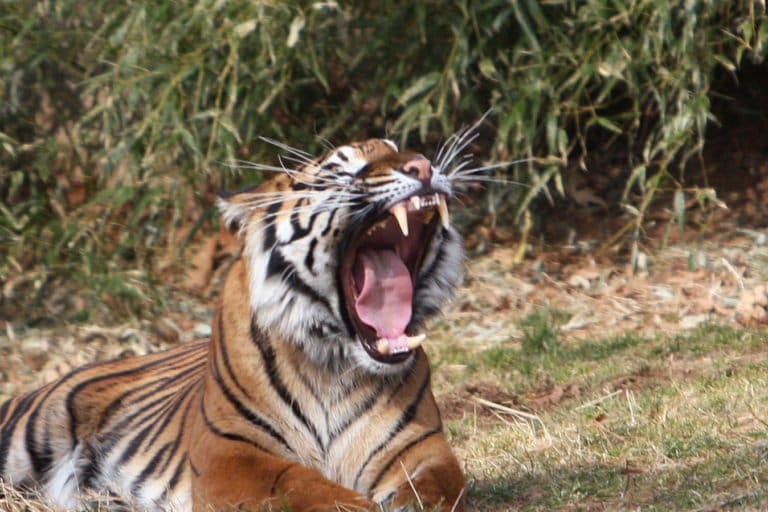
Sumatran tiger faces extinction due to wildlife trade

(02/12/2008) The critically endangered Sumatran Tiger faces extinction due to the tiger parts trade in Indonesia, reports a new report from TRAFFIC, the wildlife trade monitoring network run by IUCN and WWF.


Global warming puts penguins at risk of extinction

(02/11/2008) Climate change could put the long-term survival of sub-Antarctic King Penguins at risk by reducing the availability of prey, reports a new study published in Proceedings of the National Academy of Sciences.


Photo: Litter of naked mole rats born in time for Chinese New Year

(02/10/2008) The Bronx Zoo introduces some of its favorite little herbivore critters — a new litter of naked mole rat "pups" arriving just in time to celebrate the Lunar New Year — Year of the Golden Rat. Naked mole rats can be seen everyday at their World of Darkness exhibit. Native to the tropical grasslands of Kenya, Somalia, and Ethiopia, the Zoo's habitat gives a visual "slice of life" in a naked mole rat colony. Literally, the exhibit was designed to go deep underground to provide Zoo-goers with a view of this complex tunneling-system. Naked mole rats have a social system similar to bees with a queen (the only reproductive female), workers, and breeders.


Madagascar's tortoises at high risk of extinction

(02/07/2008) Madagascar's rare and unique turtles and tortoises face high risk of extinction in the wild if conservation measures are not rapidly put into place, warned a group of scientists meeting to discuss the fate of Madagascar's most threatened repitles.


Sea turtle makes record migration - 12,774 miles

(02/07/2008) Satellite-tagging has revealed that a leatherback sea turtle (Dermochelys coriacea) swam a total distance of 20,558 kilometers (12,774 miles) over 647 days from Jamursba-Medi, Indonesia to the coast of Oregon. The results are published in The State of the World's Sea Turtles magazine, a publication launched by conservation International and the IUCN Marine Turtle Specialist Group.


Overfishing may hurt Amazon forest trees

(02/05/2008) Overfishing is reducing the effectiveness of seed dispersal by fish in the Brazilian Pantanal, reports Nature. The research suggests that fishing practices can affect forest health.


New uakari monkey discovered in the Amazon rainforest

(02/05/2008) A previously unknown species of uakari monkey was discovered in the Brazilian Amazon, reports National Geographic News. The primate was identified after it was killed by Yanomamo Indians near the Brazil-Venezuela border.


The Panamanian golden frog declared extinct by BBC Natural History crew

(02/04/2008) A national symbol of Panama has been declared extinct by BBC filmmakers. The crew was in Panama to film the unique frog for David Attenborough's most recent series on reptiles and amphibians, entitled Life in Cold Blood. The filmmakers achieved their objective and captured the golden frog on film, including rarely seen behvaior.


Photo: Palawan peacock pheasant

(02/04/2008) NYC's Fashion Week extravaganza has nothing on some amazing colors that are on the "runway" models at the Wildlife conservation Society's Bronx Zoo headquarters. "Palooka", the Bronx Zoo's male Palawan peacock pheasant is showing off his most brilliant blue feathers this season - a sure ringer for the forecasted fall color line-up.


Giant shrew discovered in Tanzania

(02/01/2008) More than a quarter larger than all of its relations, the Grey-faced sengi (Rhynchocyon udzungwensis) was first discovered on a roll of film from camera traps set-up in the Udzungwa Mountains of Tanzania. The photos of this mysterious giant elephant-shrew were sent to expert Dr. Galen Rathbun, who has studied the sengi (or elephant-shrew) for over thirty years; after examiining the photos he believed that the animal's unique coloring proved it was an unknown species.


Arctic wolves caught on tape displaying new hunting behvaior

(01/31/2008) The BBC Natural History unit has captured footage of the Artic wolf swimming for its meal. The camera crew were filming a documentary entitled White Falcon, White Wolf on Ellesmere Island, a part of the Canadian territory of Nunavut, when they spotted this never-before-seen behvaior.


New research refutes global warming's influence on amphibians' worst enemy

(01/30/2008) There is no doubt that global warming is having a negative effect on amphibians, but it is yet unclear whether or not a direct causal relationship exists between global warming and the spread of a specific fungal epidemic wreaking havoc on amphibian populations worldwide.


Photos: Top 100 most threatened amphibians named

(01/21/2008) Due to numerous factors--including habitat destruction, pollution, climate change, and chytrid fungus--amphibians are probably the most threatened taxon of species in the world. Dr Jonathan Baillie, head of the EDGE organization which has just established an amphibian program, stated that "tragically, amphibians tend to be the overlooked members of the animal kingdom, even though one in every three amphibian species is currently threatened with extinction, a far higher proportion than that of bird or mammal species." To help save these species on the brink, EDGE, apart of the Zoological Society of London, has compiled a list of the hundred most threatened and evolutionary distinct amphibians.


Border fence may drive largest American cat to extinction

(01/21/2008) The Bush Administration's decision to not prepare a recovery plan for the endangered jaguar in its native habitat in Arizona and New Mexico may spell the end for the big cat in the United States, says an environmental group.


Photo: the night monkey

(01/20/2008) "Midget" is the youngest member of a family (six in all) of douroucoulis at the Bronx Zoo's World of Darkness. The only true nocturnal monkey, this species is also known as "owl monkey" or "night monkey".


Two-thirds of carnivores die when reintroduced into the wild

(01/20/2008) Carnivores reintroduced to the wild as part of conservation programs fare poorly, reports a new study published online in the journal Biological conservation.


Photo: guira cuckoo couple at the Bronx Zoo

(01/17/2008) The guira, a cuckoo, is one of the most common birds of Brazil. Although they live in groups of six to 18 individuals, they have a tendency to form couples.


To reproduce, parasite transforms ant into juicy red berry

(01/17/2008) Scientists have discovered a parasite that transforms the appearance of its host, an ant, into that of a juicy red berry that birds are more likely to eat and disperse into new habitats, reports an article published in The American Naturalist. It is the first example of fruit mimicry caused by a parasite, say the researchers who discovered the parasite, a nematode or roundworm found in the canopy of tropical forests ranging from Central America to the lowland Amazon.


Global warming will diminish fish catch in the Bering sea

(01/16/2008) One half of the fish caught in the U.S. annually--and almost a third worldwide--come from the Bering Sea. Yet, this vast resource is increasingly threatened by climate change. A recent study, published in Marine Ecology Progress Series, showed that global warming will greatly affect the Bering Sea's phytoplankton, the cornerstone of the sea's rich ecosystem.


Climate change causes shift in American bird ranges

(01/16/2008) Breeding ranges of North American birds have shifted northward coinciding with a period of increasing global temperatures, report researchers writing in the April issue of conservation Biology.


Photos: rare aye-aye lemur born at Bristol Zoo Gardens

(01/16/2008) Born on November 23rd, 2007 at Bristol Zoo Gardens this baby Aye-aye was given the name Raz. According to the EDGE (Evolutionary Distinct and Globally Endangered) organization this is only the second Aye-aye to be hand raised in the UK.


Scientists discover four species of anole lizards in 24 hours in Panama

(01/13/2008) In January of 2006 a biological expedition uncovered four anole species in a single day. Dr. Gunther Koehler, a member of the expedition, described the discoveries as "a once in a life time experience; during expeditions before, we had found new species, one at a time--but four species within 24 hours, that was incredible!"


Dirt-munching helps protect chimps from malaria

(01/10/2008) Soil ingestion helps chimps protect themselves from malaria, reports a new study published in the journal Naturwissenschaften. Apparently geophagy, as the deliberate behvaior is known, increases the potency of ingested plants with anti-malarial properties.


An interview with primate researcher Dr. Karen Strier: America's largest monkey recovering after brush with extinction

(01/10/2008) The Atlantic forest of Brazil boasts South America's largest primates, the Southern and Northern Muriqui. The muriqui are unique among all primates, because they are not territorial and do not display aggressive behvaior. The IUCN has classified the Southern Muriqui as endangered, while the Nothern Muriqui is critically endangered. Dr. Karen Strier has studied the Northern Muriqui in the field for twenty-five years. A professor of zoology and anthropology at the University of Madison Wisconsin, she is the author of Faces in the Forest: the Endangered Muriqui Monkeys of Brazil and a new textbook entitled Primate behvaioral Ecology.


Disappearance of elephants, giraffes causes ecological chain reaction

(01/10/2008) The disappearance of elephants, giraffes and other grazing animals from the eastern African savanna could send ecological ripple effects all the way to the savanna's ants and the acacia trees they inhabit, warns a new study published in the journal Science.


Male lion licking a female's head

(01/08/2008) Bronx Zoo's newest lions, male M'wasi and female Sukari, have recently been introduced on the Zoo's Africa Plains. A typical lion greeting is quick, lasting less than a minute, and includes touching heads.


Photos: Hippos threatened in Africa

(01/07/2008) As the sun sets on the Luangwa River in Zambia, a male hippo throws its mouth open in a yawn as wide as a canyon. Night is falling as the hippo herds break to the banks to follow their regular paths to their feeding grounds. Their huge, round hooves made muddy imprints during the rainy season, and have dried to concrete craters along a trail the hippos follow to graze in grassy glades.


Three salamander species discovered in Costa Rica

(01/06/2008) Scientists from the Natural History Museum of London have discovered three new species of salamander in south-eastern Costa Rica. This brings the nation's total to forty-three species, meaning that this small tropical nation contains approximately nine percent of the world's salamanders.


Nature tourism taking a toll in the Galapagos

(01/05/2008) A booming "ecotourism" industry is bringing new threats to the Galapagos, reports a feature in the Wall Street Journal.


Butterfly tricks ants into caring for its young

(01/03/2008) A species of butterfly in Denmark foolds ants into raising their larvae, reports research published in the journal Science.


Photo: Pygmy marmoset twins born at the Bronx Zoo

(01/03/2008) Twin pygmy marmosets born to three-year-old mom, Squirt, and seven-year-old dad, King at the Bronx Zoo on November 11 are doing well, according to zoo officials.


Orangutan should become symbol of palm-oil opposition

(01/02/2008) In a letter published today in Nature, Oscar Venter, Erik Meijaard and Kerrie Wilson argue that proposals for conservation groups to purchase and run oil palm plantations for the purpose of generating funds for forest protection are unlikely to be successful. The concept was originally put forth by Lian Pin Koh and David S. Wilcove in a 2007 Nature article.


As amphibians leap toward extinction, alliance pushes "The Year of the Frog"

(12/31/2007) With amphibians experiencing dramatic die-offs in pristine habitats worldwide, an alliance of zoos, botanical gardens and aquariums has launched a desperate public appeal to raise funds for emergency conservation measures. Scientists say that without quick action, one-third to one-half the world's frogs, toads, salamanders, newts and caecilians could disappear.


6 species of giraffe "discovered"

(12/21/2007) Genetic analysis that the world's tallest animal--the giraffe--may actually be several species, according to a study published in the open access journal BMC Biology. Existing taxonomy recognizes only one species of giraffe.


Squirrels use snake skin to disguise themselves from predators

(12/20/2007) California ground squirrels and rock squirrels chew up rattlesnake skin and smear it on their fur to mask their scent from predators, according to a new study by researchers at UC Davis. Barbara Clucas, a graduate student in animal behvaior at UC Davis, observed ground squirrels (Spermophilus beecheyi) and rock squirrels (Spermophilus variegates) applying snake scent to themselves by picking up pieces of shed snakeskin, chewing it and then licking their fur.


Thailand's forests could support 2,000 tigers

(12/19/2007) Thailand's network of parks could support 2,000 tigers, reports a new study by Thailand's Department of National Park, Wildlife, and Plant conservation and the New York-based Wildlife conservation Society.


Migrating frogs fare poorly when habitat altered

(12/19/2007) Habitat loss and fragmentation are putting amphibians already threatened by climate change, pesticides, alien invasive species, and the outbreak of a deadly fungal infection at greater risk of extinction, reported a study published in Science last week.


Evolution of whales challenged

(12/19/2007) Modern whales appear to have evolved from a raccoon-sized creature with the body of a small deer, according to scientists writing in the journal Nature. The results challenge the theory that cetaceans are descended from even-toed ungulates (artiodactyls) like hippos, as previous molecular analysis has suggested.


Study shows that sea turtles can recover

(12/18/2007) conservation of sea turtle nesting sites is paying off for the endangered reptiles, reports a new study published this week in the journal Global Ecology and Biogeography. A team of researchers led researchers from IUCN and conservation International found that green turtle (Chelonia mydas) nesting on four beaches in the Pacific and two beaches in the Atlantic have increased by an four to fourteen percent annually over the past two to three decades as a result of beach protection efforts.


Photos: Two unknown mammal species discovered in "lost world"

(12/16/2007) Two mammal species -- a tiny possum and a giant rat — discovered on a recent expedition to Indonesia's remote Foja Mountains in New Guinea are likely new to science, report researchers from conservation International (CI) and Indonesia Institute of Science (LIPI). The area won international fame after a December 2005 survey turned up dozens of new species and gave urgency to conservation efforts in a region where logging and forest clearing for agriculture are a serious concern.


Traffic cones used to protect seabirds

(12/11/2007) Bright orange traffic cones that warn drivers of danger on the road are now being used to steer seabirds away from deadly entanglement in fishing nets, the Wildlife conservation Society (WCS) reports. Argentinean marine biologist and inventor Diego Gonzalez Zevallos has conducted research funded by WCS and Fundacion Patagonia National on the issue for over five years.


Threatened birds may be rarer than previously thought, finds study

(12/11/2007) Geographic range maps that allow conservationists to estimate the distribution of birds may vastly overestimate the actual population size of threatened species and those with specific habitats, according to a study published online this week in the journal conservation Biology.


Photos: Elusive long-eared jerboa caught on film for the first time

(12/10/2007) Extraordinary footage of the endangered long-eared jerboa was taken by scientists from the EDGE; this is the first time the jerboa, a hopping rodent that sports massive ears, has ever been caught on film. The nocturnal animal was captured springing across the desert sands, digging a burrow, and, oddly enough, persistently seeking the comfort of a scientist's sandals.


World's largest spitting cobra discovered in Kenya

(12/09/2007) The world's largest spitting cobra has been discovered in Kenya, according to WildlifeDirect, a conservation group.


Global warming will significantly increase bird extinctions

(12/06/2007) Where do you go when you've reached the top of a mountain and you can't go back down? It's a question increasingly relevant to plants and animals, as their habitats slowly shift to higher elevations, driven by rising temperatures worldwide. The answer, unfortunately, is you can't go anywhere. Habitats shrink to the vanishing point, and species go extinct. That scenario is likely to be played out repeatedly and at an accelerating rate as the world continues to warm, Stanford researchers say.


Pictures of new species discovered in West Africa

(12/06/2007) Scientists have discovered significant populations of new, rare and threatened species in one of the largest remaining blocks of tropical forest in West Africa, reports conservation International (CI). The findings underscore the need to conserve the area's high biological richness.


Photo: snowy owl gets his inoculations

(12/06/2007) Dr. Robert Moore, Wildlife conservation Society Veterinarian, assisted by Nancy Gonzalez, Senior Bird Keeper, and Shanna Hall, Bird Keeper, are readying Hedwig, a snowy owl at the Wildlife conservation Society's Bronx Zoo, for his favorite weather - COLD.


Photo: Bronx Zoo has bred 80 endangered snow leopard

(12/06/2007) The Snow Leopard, hunted for its attractive coat, is an endangered species found in the mountain ranges of central and southern Asia. After reaching a population low during the 1960s when only around 1000 individuals remained, the cat has staged a recovery thanks to conservation efforts both in its native habitat and captivity.


Blue-eared pheasant in the snow at Central Park Zoo

(12/06/2007) Snow showers heightened the holiday mood today at the Central Park Zoo, a Wildlife conservation Society park in New York City. Our blue-eared pheasant took in the weather from his sentinel post at the Tisch Children's Zoo. Its distinctive white feathers that look like ears start beneath its chin and extend above the head.


Rare gorillas use weapons to attack forest-intruding humans

(12/05/2007) Following the first documented cases of the Cross River gorillas -- world's most endangered gorilla -- throwing sticks and clumps of grass when threatened by people, the Wildlife conservation Society (WCS) has announced new research to better protect the species from poaching and encroachment.


Page 1 | Page 2 | Page 3 | Page 4 | Page 5 | Page 6 | Page 7 | Page 8 | Page 9 | Page 10 | Page 11 | Page 12 | Page 13 | Page 14 | Page 15 | Page 16 | Page 17 | Page 18 | Page 19 | Page 20 | Page 21 | Page 22 | Page 23 | Page 24 | Page 25 | Page 26 | Page 27 | Page 28 | Page 29 | Page 30 | Page 31 | Page 32 | Page 33 | Page 34 | Page 35 | Page 36 | Page 37 | Page 38 | Page 39 | Page 40 | Page 41 | Page 42 | Page 43 | Page 44 | Page 45 | Page 46 | Page 47


home | archives | news | XML / RSS feeds


XML / RSS / Syndication options

mongabay.com features more than 250 RSS feeds to meet your specific area of interest


WEEKLY NEWSLETTER
Email:


SUPPORT
Mongabay.com seeks to raise interest in and appreciation of wild lands and wildlife, while examining the impact of emerging trends in climate, technology, economics, and finance on conservation and development (more)

Help support mongabay.com when you buy from Amazon.com. Or donate to Mongabay directly


ABOUT
Mongabay provides conservation and environmental science news, information, and analysis.


About Mongabay
Founder: Rhett Butler
Copyright & Use
Contact
Contribute
Internships
Nature Blog Network


POPULAR PAGES
Rainforests
Rain forests
Amazon deforestation
Deforestation
Deforestation stats
Why rainforests matter
Saving rainforests
Amazon rainforest
Congo rainforest
Deforestation data
Rainforest canopy
For kids

Special sections
New Guinea
Finding new species
Sulawesi
Madagascar
Rainforests
Borneo
REDD
News
Most popular articles
Africa
Amazon
Animals
Brazil
Conservation
Climate Change
Deforestation
Energy
Featured
Happy-upbeat
Indonesia
Interviews
Madagascar
New species
Oceans
Palm oil
Rainforests
Strange
Wildlife
MORE TOPICS


PHOTOS
Indonesia photos
Brazil

Costa Rica photos
Costa Rica

Colombia photos
Colombia

Indonesia photos
Indonesia

Madagascar photos
Madagascar

Malaysia photos
Malaysia

Monkey photos
Monkeys

Peru photos
Peru

Colombia photos
Rainforests


All galleries


RELATED TOPICS

default related topics content


BLOGROLL/LINKS

default blogroll links content


Copyright mongabay1999-2013


Carbon dioxide (CO2) emissions generated from mongabay.com operations (server, data transfer, travel) are mitigated through an association with Anthrotect,
an organization working with Afro-indigenous and Embera communities to protect forests in Colombia's Darien region.
Anthrotect is protecting the habitat of mongabay's mascot: the scale-crested pygmy tyrant.